
The True Cost of Poor Turnover Management in Short-Term Rentals
Turnover is one of those things that looks simple from a distance.
A guest checks out. Clean the place. Reset the space. Welcome the next guest.
In reality, that short window between stays carries more financial weight than most owners expect. When turnover management slips, the consequences rarely show up as one dramatic failure. They appear quietly. Missed same-day bookings. Rushed cleanings. Small issues that snowball into negative reviews.
Over time, poor turnover management in short-term rentals becomes expensive in ways that are easy to overlook and hard to reverse.
Why turnover is more than just cleaning
Turnover often gets reduced to cleaning schedules. And cleaning is a big part of it. But it is not the whole picture.
True turnover management includes inspection, communication, maintenance follow-up, supply resets, and timing coordination. When any one of those breaks down, the ripple effects show up quickly.
A cleaner finishes late. Maintenance is flagged but not addressed. A guest arrives early and notices something that should have been fixed days ago.
None of these issues seem catastrophic on their own. But together, they create friction. And friction is what guests feel most sharply.
The hidden costs of rushed transitions
One of the most common mistakes is trying to compress turnover into the smallest possible window without adjusting expectations.
Fast turnovers are not inherently bad. But rushed turnovers often are.
When teams are pressured to move too quickly, quality drops. Small details get missed. Supplies are restocked inconsistently. Wear and tear goes unnoticed until it becomes damage.
Those small misses show up later as complaints, refunds, or poor reviews. And once reviews dip, booking momentum usually follows.
This is how poor turnover management quietly eats into revenue without showing up clearly on a spreadsheet.
Missed bookings are often self-inflicted
Owners tend to blame slow periods on seasonality or platform algorithms. Sometimes that is fair.
Other times, the issue is readiness.
If a property is not reliably turned over on time, owners hesitate to open same-day gaps. If cleaning quality is inconsistent, calendars stay blocked longer than necessary. If inspections are rushed, owners leave buffers “just in case.”
Those buffers feel safe. But they reduce bookable nights.
Over a year, even a few blocked nights per month add up. And those losses rarely get labeled as turnover problems, even though that is where they started. It’s part of why you’re seeing owners increasingly chasing reliable cash flow over upside — predictable bookable nights matter more than theoretical appreciation.
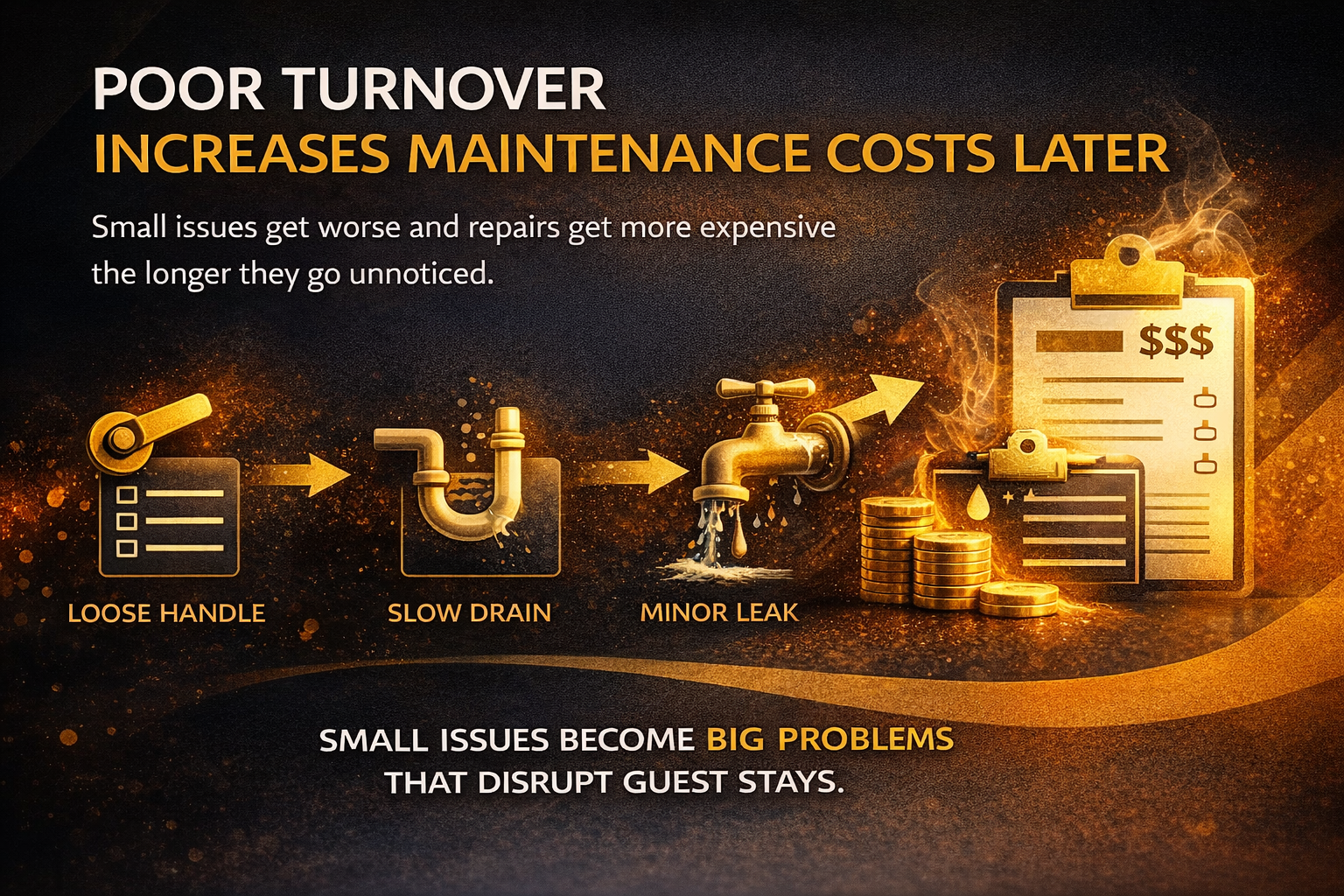
Poor turnover increases maintenance costs later
Maintenance issues do not usually announce themselves loudly at first.
A loose handle. A slow drain. A minor leak. These are the things a proper turnover inspection catches early.
In markets like Seattle, where short-term rentals often rely on older housing stock, addressing these small issues early may also involve targeted upgrades or remodels, something experienced home remodeling experts in Seattle often recommend to prevent recurring turnover-related repairs.
When inspections are skipped or rushed, minor issues linger. They get worse. And eventually, they cost more to fix and disrupt guest stays.
This is why maintenance and turnover are inseparable. The long-term cost of neglect is far higher than the short-term effort it takes to stay ahead.
A closer look at 5 Essential Maintenance Tips for Short-Term Rental Properties explains how regular checks during turnover prevent expensive surprises later.
Cleaning quality directly affects guest trust
Guests notice cleanliness immediately. Not in a technical way, but emotionally.
Clean spaces feel safe. Organized. Cared for.
Inconsistent cleaning creates doubt. And once doubt sets in, guests look for more problems. They notice dust. They question linens. They scrutinize everything else.
This is why cleaning and turnover are the backbone of a successful vacation rental, not just an operational task. Cleanliness shapes first impressions, and first impressions shape reviews.
When cleaning teams are rushed or poorly coordinated, quality suffers. Not because they do not care, but because systems are working against them.
Turnover mistakes compound across platforms
One poor turnover can affect more than one booking.
A delayed check-in creates stress. A stressed guest leaves a review. That review impacts future booking decisions. Lower booking velocity then pressures pricing. Pricing pressure leads to faster turnovers. And the cycle repeats.
This is how small operational issues turn into larger business problems.
The cost is not just the refund or the extra cleaning. It is the long-term erosion of trust and momentum.
Why turnover problems feel exhausting to manage
Turnover issues often create emotional fatigue.
Owners feel constantly “on call.” Every checkout feels tense. Every gap feels risky. Instead of feeling like a system, turnover feels like a series of fires to put out.
That stress leads to reactive decisions. Shortcuts. Temporary fixes that become permanent habits.
Over time, the operation becomes fragile. One delay throws everything off. One sick cleaner causes panic. One maintenance issue derails the schedule.
This is where professional property managers often make the biggest difference. Not by working faster, but by building buffers, systems, and accountability into the process.
Predictable turnover creates calmer operations
Good turnover management is boring. And that is a compliment.
When systems work, nothing stands out. Guests arrive on time. Spaces are ready. Issues are addressed quietly before they become visible.
Predictability reduces stress for everyone involved. Cleaners know what to expect. Maintenance knows when to intervene. Guests trust the process.
And trust shows up as better reviews, fewer complaints, and more repeat bookings over time.
Turnover quality affects long-term guest retention
Guests may forgive one small issue. They rarely forgive patterns.
If turnover-related issues repeat, guests remember. They hesitate to return. They mention it in reviews. They choose differently next time.
This is how turnover management connects directly to guest retention. Not through flashy features, but through consistency.
Guests return to places that feel reliably cared for. Not perfect. Just steady.
Where management systems help most
Strong turnover systems are difficult to maintain casually, especially as booking volume increases.
Coordinating cleaning, inspections, maintenance, and guest communication across multiple stays requires structure. This is where experienced property managers help stabilize operations without adding complexity.
By standardizing checklists, timelines, and accountability, turnover stops feeling like a risk point and starts functioning like a reliable process.
That reliability is what allows owners to focus on growth instead of constant troubleshooting.
Poor turnover is expensive, even when it looks manageable
The true cost of poor turnover management in short-term rentals rarely appears as a single line item.
It shows up as lost nights. Lower ratings. Higher maintenance bills. Emotional burnout. Slower growth.
Individually, these costs feel manageable. Together, they create drag.
And drag is what keeps otherwise strong properties from reaching their potential.
A practical next step
If turnover feels stressful, rushed, or unpredictable, it is usually a systems issue, not a people issue.
At Book It Vacation Rentals, we help owners build turnover processes that are consistent, calm, and scalable. Not rushed. Not reactive. Just reliable. If that sounds like the direction you want to move in, we would be glad to talk and see whether working together makes sense.
FAQs
What is turnover management in short-term rentals?
A It includes cleaning, inspections, maintenance follow-up, restocking, and coordination between guest stays.
How does poor turnover management affect revenue?
A: It leads to missed bookings, lower reviews, higher maintenance costs, and reduced guest trust over time.
Is fast turnover always a problem?
A: No. Fast turnover works when systems support quality. Problems arise when speed replaces consistency.
Why does cleaning matter so much to guests?
A: Cleanliness shapes first impressions and trust. Inconsistent cleaning leads guests to question everything else.
Can professional property managers improve turnover systems?
A: Yes. Structured processes reduce stress, improve consistency, and prevent small issues from becoming costly problems.